Professional development workshop

Tornadoes in February? It's Michigan!

The role of air masses on weather in Michigan and elsewhere

For
Middle school
Length
3 hours, with a 15-minute break
Credit
3 SCECHs
Price
$250-$350 depending on group size
A tornado touching down over open farmland under a dark storm

Much of the unpredictability of Michigan’s weather is attributable to air masses. The goal of this workshop is to provide middle school teachers with the content mastery necessary to teach Michigan’s academic science standard MS-ESS2-5: to “collect data to provide evidence for how the motions and complex interactions of air masses result in changes in weather conditions.”
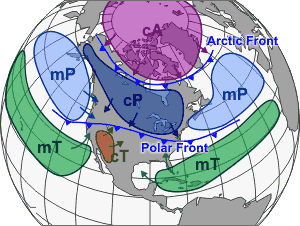
Map of the major air masses that affect North America
Major air masses that affect North America. Source: NOAA JetStream.

Climate first, then air masses

As an important context for understanding the effect of air masses upon weather in Michigan, the factors behind our existing patterns of seasonality, that is, our climate, are covered first. Participants are then able to better appreciate what the impacts of air masses are.

Real-time data your students can use

Participants are introduced to several sources of real-time weather data, including the American Meteorological Society, the National Weather Service and the Wyoming Weather Web, among others. These are the same sources students can use to collect the evidence the standard asks for.

Format

The workshop is three hours long, with a 15-minute break, and is worth 3 SCECHs. Handouts with suggested in-class activities are provided.

What participants take away

  • Content mastery for Michigan's MS-ESS2-5: collect data to provide evidence for how the motions and complex interactions of air masses result in changes in weather conditions
  • The factors behind Michigan's patterns of seasonality, so the effect of air masses makes sense in context
  • The major air masses that affect North America and what each brings
  • Hands-on introductions to real-time weather data from the American Meteorological Society, the National Weather Service and the Wyoming Weather Web
  • Handouts with suggested in-class activities
  • 3 SCECHs

Other workshops

Kindergarten, 3rd grade and middle school

Will it get too warm in the car for Lucky?

Why does a parked car get so hot? Teachers learn the greenhouse effect through an everyday example, then learn to calculate sun angle for any day of the year, anywhere on Earth.

Length
2 hours
Credit
2 CEUs / SCECHs
Standards
Weather and climate standards, K through middle school

Middle school

Why isn't the Equator the hottest place on Earth?

Probably the most important diagram in Earth science, explained so you can teach it. Uneven heating, Earth's rotation, and the global pattern of winds and pressure that shape regional climates.

Length
2 hours
Credit
2 CEUs / SCECHs
Standards
NGSS MS-ESS2-6

Elementary grades

Introducing elementary students to world climates through math

Students classify the world's climates using annual temperature and precipitation data and nothing more than addition, averages, ranges and decimals. Teachers learn the method behind Köppen's system and how to run it in class.

Length
2 hours
Credit
2 CEUs
Standards
Elementary weather and climate standards, with math integration

Bring “Tornadoes in February? It's Michigan!” to your district

Workshops run two to three hours at a location you choose, and cost %!s(<nil>). Continuing education credits are awarded.